Ending Coercive Offending (ECO) – Theory of Change
The Problem
Children who are coerced into offending through exploitation (including county lines, violence, and drug-related harm) are routinely criminalised rather than safeguarded. Despite policy recognition of exploitation, criminal justice objectives continue to outweigh welfare considerations, resulting in long-term harm and injustice.
If…
Systems and decision-makers are challenged to recognise coercion, grooming, and power imbalance as central to children’s offending behaviour, and safeguarding responses are prioritised over criminal justice outcomes.
Then…
Children will be less likely to be criminalised for exploitation-linked harm, and more likely to receive protection, support, and proportionate responses that reduce long-term harm.
Because…
Criminalisation compounds exploitation, entrenches inequality, and undermines safeguarding duties — whereas prevention and early intervention reduce harm, improve outcomes, and align systems with children’s rights
ECO’s Role
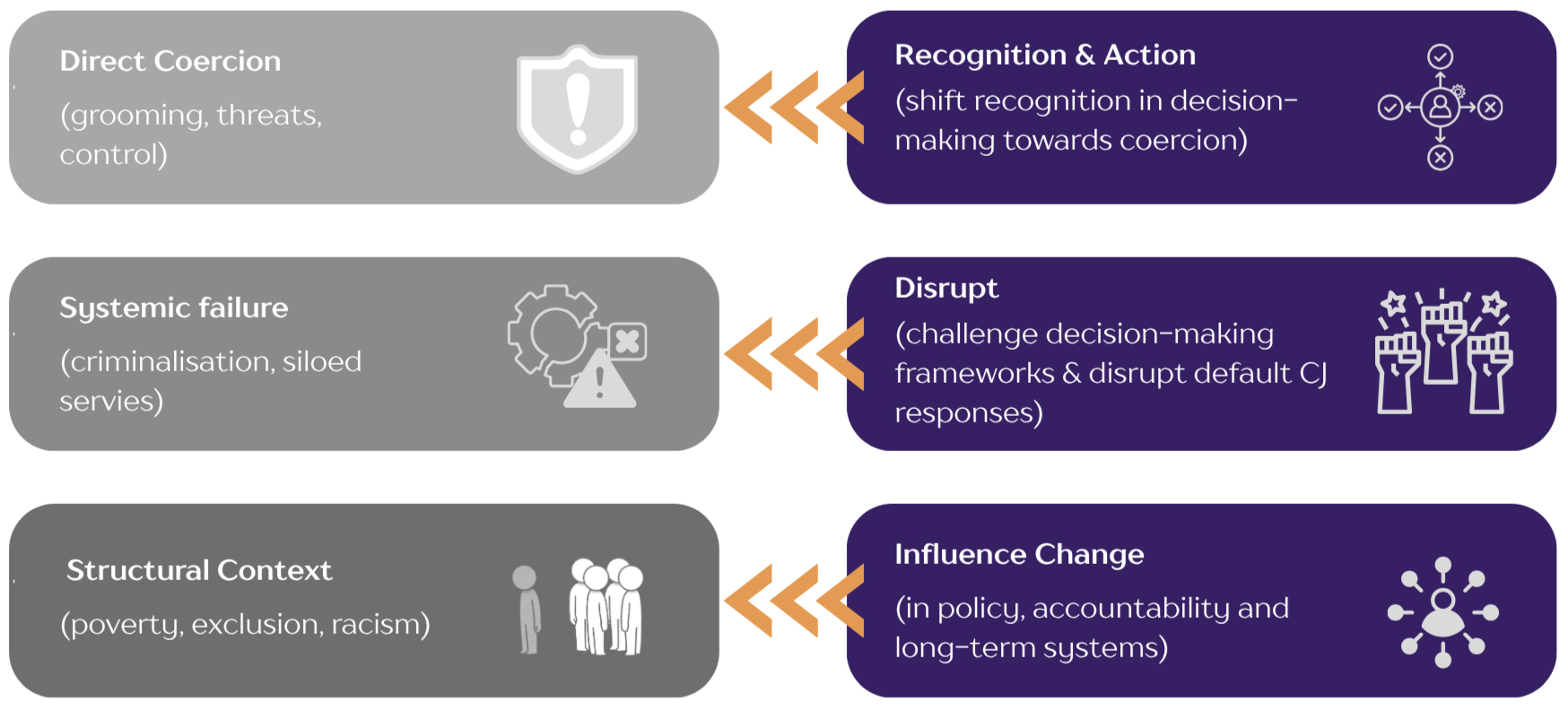
ECO work is underpinned by the theory of social entrapment. Our work advocates intervention at a direct level, acknowledges and challenges systemic failure and recognises the structural context by:
Challenging decision-making frameworks
Disrupting processes that default to criminal justice responses
Influencing policy, practice, and system accountability

Securing Long-Term Change
Safeguarding responses consistently outweigh punitive outcomes
Exploited children are recognised and treated as victims
Criminalisation of coerced children is reduced at scale