
Hard to Reach… or Deliberately Erased?
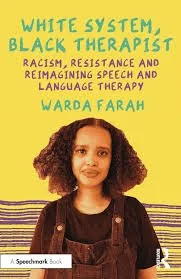
I count myself fortunate to know Warda Farah, whose book White System, Black Therapist: Racism, Resistance and Reimagining Speech and Language Therapy is both courageous and thought-provoking.
As I reached the conclusion, Unbecoming and Imagining Something New, one short section stopped me in my tracks.
Its title simply reads: Not "Hard to Reach” but Deliberately Erased. For years, I have challenged the phrase hard to reach. Whether referring to children, families or communities, I've never believed people are inherently difficult to reach. More often, they have been failed by services that have not taken the time to understand them, build trust or work differently.
Warda Farah takes this challenge even further. She writes:
"We often talk about marginalised children or communities as though they are "hard to reach' or 'seldom heard". Yet it may be more honest to say we've actively erased or minimised them.” (Pg 141)
That is a profound observation. It asks us to move beyond the comforting language of professional practice and confront a far more difficult question. What if the issue isn't that children are hard to reach? What if we have become accustomed to not working to ensure we reaching them?
At ECO, we work alongside exploited children who have been criminalised. These are children who have often experienced grooming, coercion and exploitation before finding themselves viewed primarily through the lens of offending rather than victimhood. Too often, they become visible only when they enter the criminal justice system. Until then, their voices are overlooked, their experiences are questioned. Their identities are reduced to labels that obscure the harm they have endured.
This is where the work of Jahnine Davis is so important. Her work on adultification and conditional safeguarding reminds us that some children are afforded less protection than others. Childhood itself can become conditional, influenced by race, age, gender, poverty and other intersecting identities that shape how children are perceived and how deserving they are considered to be.
These are uncomfortable truths - But uncomfortable truths deserve our attention.
When exploited children are repeatedly treated as offenders before they are recognised as victims, we have to ask ourselves difficult questions. Are we simply failing to hear them? Or have we become so familiar with particular narratives about certain groups of children that we no longer notice whose voices are missing? I don't pretend to know the answer, but certainly have an opinion based on years of work within the sector.
What I do know that the language we choose matters. Describing children as hard to reach subtly places responsibility with them.
Asking whether they have instead been overlooked, minimised or erased places responsibility where it belongs—with the systems, organisations and professionals who have the power to do better. Perhaps that is the challenge Warda Farah leaves us with.
Not to ask why some children are so difficult to engage, but to ask why our systems continue to find it so easy not to see them.
At ECO, we believe every exploited child deserves to be seen, heard and protected. That begins by questioning the language we use, the assumptions we make and the stories we continue to tell ourselves about the children who need us most.
Perhaps it is time we stopped asking why some children are hard to reach and started asking whether we have become too comfortable with not reaching them at all.
Written by: Sherry Peck