
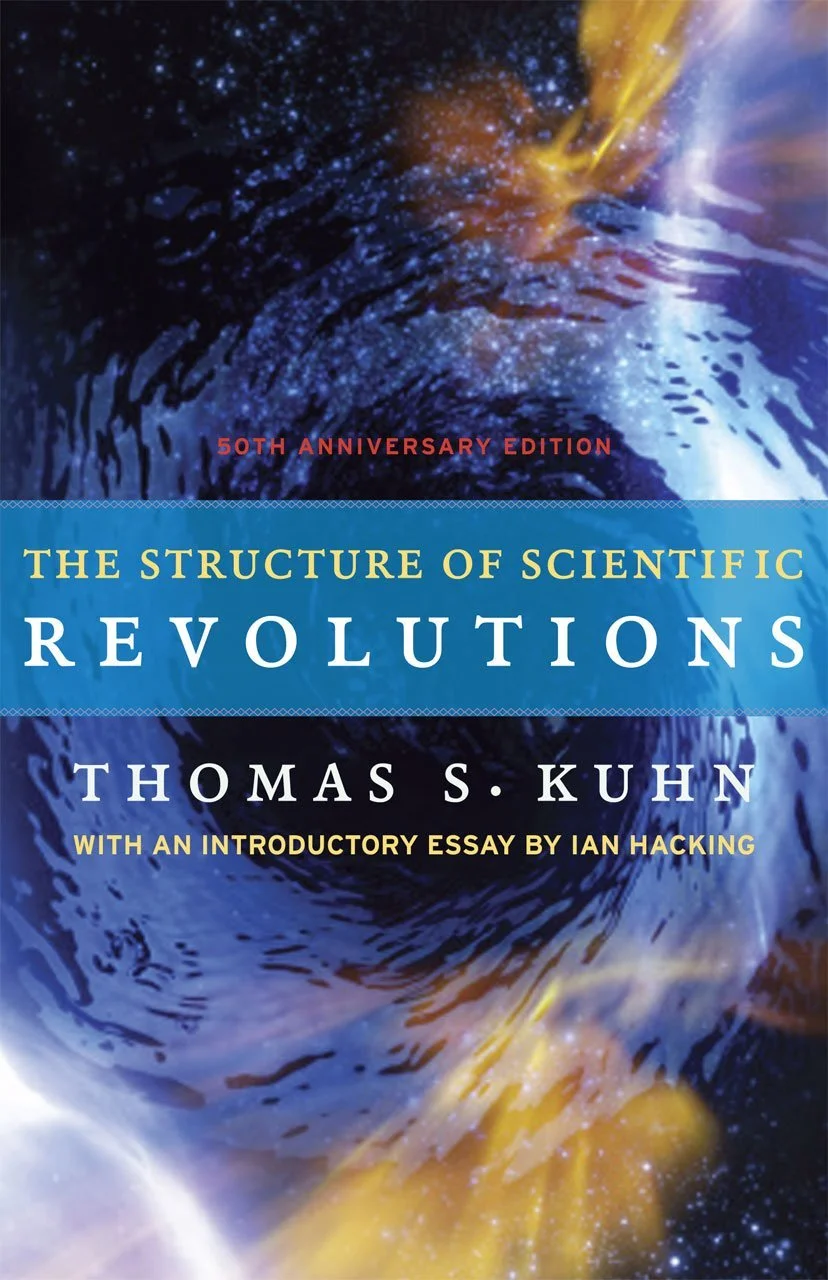
There are some books you race through.
There are others that make you stop every few pages, reread the same paragraph and wonder whether you're any wiser than when you started.
For me, The Structure of Scientific Revolutions by Thomas S. Kuhn is firmly in the second category.
Recently, I was chatting with one of the most outstanding academics I know and confessed that I was struggling to read it. He laughed and said, "Don't worry. Almost nobody reads Kuhn these days. They quote someone else who's read him.” I laughed too, It was strangely reassuring. The truth is, I'm still wrestling with it.
But sometimes the books we struggle with are the ones that we need to persist with. Kuhn introduced the idea of a paradigm shift—those moments when our existing way of understanding the world no longer works. Rather than changing gradually, societies sometimes reach a point where the old explanations can no longer account for what is happening. The tensions build until a completely different way of thinking begins to emerge; I am hopeful that we will see that soon as we think about the children we criminalise.
For years, we have responded to exploited children through systems that too often define them by what they have done rather than by what has happened to them. We have become accustomed to seeing criminalisation, exclusion and enforcement as normal responses to children whose lives have frequently been shaped by grooming, coercion and exploitation. But what if those responses are themselves the anomalies?
What if the increasing evidence that exploited children are being failed by our systems is telling us that our current way of thinking has reached its limits?
History reminds us that societies do change. There was a time when many accepted that child labour was inevitable, there was a time when racial segregation was defended as normal, there was a time when many believed that women should not vote.
Each of those beliefs eventually gave way to a new understanding of justice. Not because society evolved quietly, but because enough people began asking whether the existing paradigm could still be justified.
Perhaps safeguarding now stands at a similar crossroads, perhaps the question is no longer whether exploited children should be criminalised. Perhaps the question is why we have accepted that approach for so long.
Paradigm shifts rarely happen because one person has all the answers. They happen because enough people become willing to question assumptions that once appeared beyond challenge.
I don't yet pretend to fully understand everything Kuhn was trying to tell us. I'm still reading, still thinking, still wrestling with his ideas. But if his work teaches us anything, it is this:
Real change begins when we find the courage to question what everyone else has come to regard as normal.
At ECO, we believe that exploited children deserve more than incremental improvements to existing systems. They deserve a fundamental shift in how they are understood, how they are treated and how society responds to the harm they have experienced.
Perhaps that is the paradigm shift our children have been waiting for.
Written by: Sherry Peck